When Your Archive Has to Survive a Courtroom
You can archive your website every day for a decade. But the archive only has value if it holds up when someone challenges it.
That challenge usually comes in one of three forms: a regulator asking you to prove what was published on your website on a specific date, opposing counsel questioning the authenticity of digital evidence you have submitted, or an internal investigation requiring an unimpeachable record of what your organisation’s website displayed at a critical moment.
In each case, the question is not whether you have an archive. It is whether your archive constitutes credible evidence. And the answer depends almost entirely on the format you chose to store it in.
The Problem With Proprietary Archives
Several web archiving vendors store captures in proprietary formats – internal databases, custom file structures, or vendor-specific containers. The archive is accessible through the vendor’s platform and can be viewed, searched, and exported from their interface.
This works perfectly well until the archive needs to stand on its own.
In a legal or regulatory proceeding, the opposing side will probe the reliability of your evidence. With a proprietary format, the questions are uncomfortable:
“How do we know this archive accurately represents what was on the website?” With a proprietary format, the answer is essentially: “Because the vendor says so.” There is no independent way to verify the archive without the vendor’s software.
“Can an independent expert examine this archive?” If the format is proprietary, only the vendor’s tools can read it. Independent forensic analysis requires open, documented formats.
“What happens if the vendor goes out of business?” If your archives are locked in a proprietary format and the vendor disappears, you may lose access to your own evidence. This is not a hypothetical concern in a market where vendors regularly pivot, get acquired, or shut down product lines.
“Has this archive been modified since capture?” Proprietary formats often lack built-in integrity verification. The vendor may have access controls and audit logs, but these are assertions of integrity, not proofs.
These questions do not arise with WARC files.
What Makes WARC Different
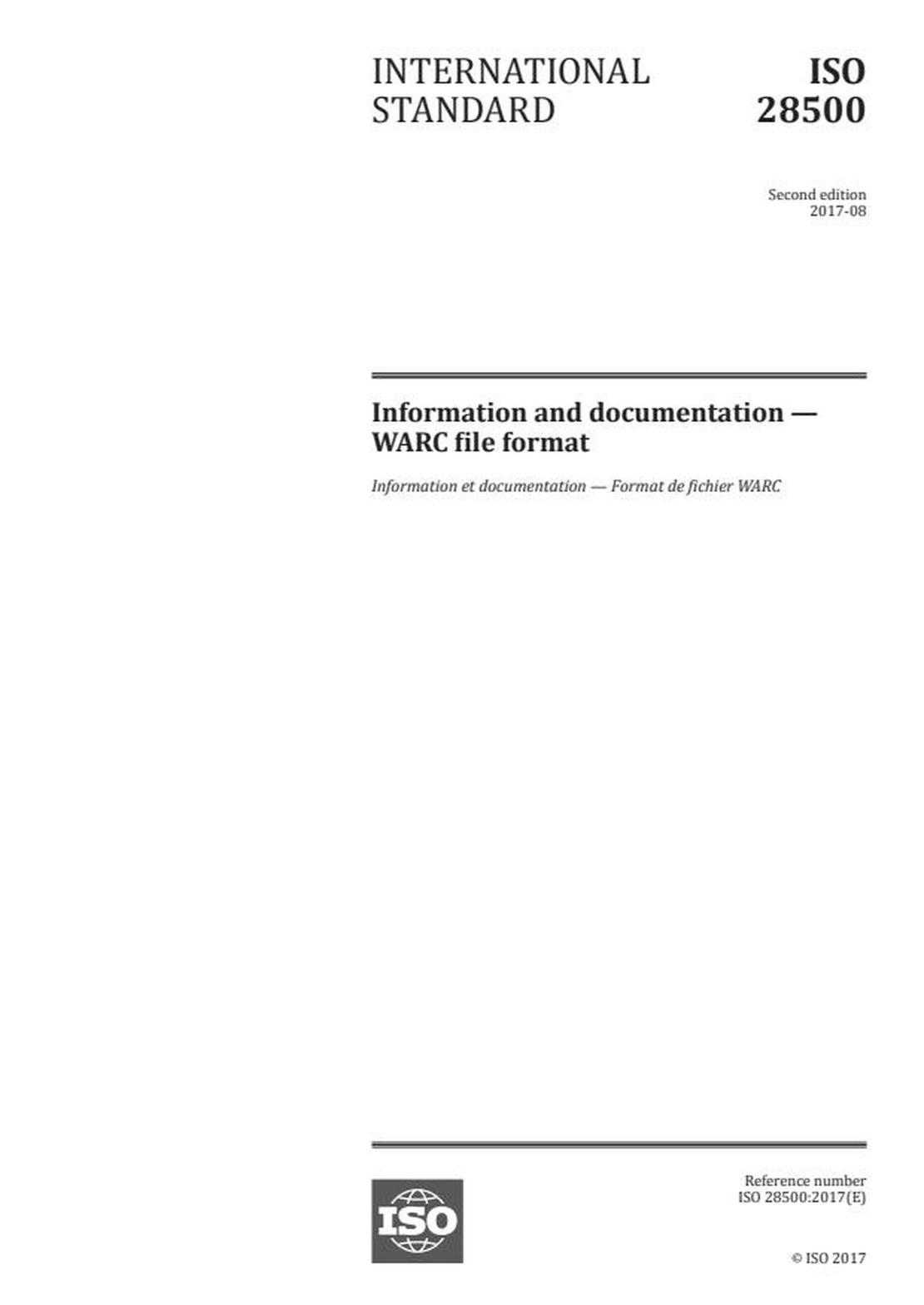
WARC – Web ARChive – is an open file format defined by ISO 28500, an international standard maintained by the International Organization for Standardization. First published in 2009 and updated in 2017, ISO 28500 specifies exactly how web content must be structured, stored, and described within a WARC file.
Three characteristics of WARC make it fundamentally different from proprietary alternatives.
1. Open and Documented
The WARC specification is publicly available. Any software developer can build tools to read, write, and validate WARC files. Dozens of open-source tools already exist for working with WARC content, including the tools used by the Internet Archive, national libraries, and government archiving programmes.
This means your archives are never locked to a single vendor. If you change providers, your WARC files go with you. If your vendor disappears, your archives remain readable. If a court requires independent forensic examination, any qualified expert can analyse the files using standard, well-documented tools.
2. Complete by Design
A WARC file does not store a simplified version of a web page. It stores the complete HTTP transaction: every request sent to the server, every response received, every header, every resource – HTML, CSS, JavaScript, images, fonts, media files – with precise timestamps recording when each element was captured.
This completeness matters in legal contexts because it eliminates ambiguity. A screenshot shows what appeared on screen at one viewport size. A PDF shows a flattened rendering of the content. A WARC file shows exactly what the server delivered and exactly how the page was constructed – the technical equivalent of producing the original document rather than a photocopy.
3. Verifiable
WARC files can be paired with cryptographic hashing to create tamper-evident archives. When a WARC file is created, each record can be hashed with algorithms like SHA-512 or RIPEMD-160. These hashes produce a unique digital fingerprint for every captured resource. If even a single byte of the archive is modified after capture, the hash will no longer match, immediately revealing the alteration.
This is not a feature of the WARC format itself – it is a practice that responsible archiving providers build on top of WARC. But the open, well-structured nature of WARC makes this kind of verification straightforward to implement and independently auditable.
How Courts and Regulators Evaluate Digital Evidence
Understanding how legal and regulatory bodies assess digital evidence helps explain why the format matters so much.
Authentication
Under rules of evidence in most jurisdictions (including the US Federal Rules of Evidence, particularly Rules 901 and 902), digital evidence must be authenticated – the proponent must demonstrate that the evidence is what it purports to be. For web archives, this means proving that the archive accurately represents what was published on the website at the stated time.
An archive stored in an ISO-standard format with cryptographic integrity verification provides a clear authentication chain: the capture was performed by documented software, stored in a standardised format, and verified by mathematical proof against tampering. An archive stored in a proprietary format relies on the vendor’s testimony that their system is reliable – a weaker foundation.
Chain of Custody
Legal proceedings require demonstrating an unbroken chain of custody for evidence. Who captured the archive? When? Where has it been stored? Who has had access? Has it been modified?
WARC files, combined with WORM (Write Once Read Many) storage and cryptographic hashes, create a chain of custody that is both documentable and independently verifiable. The archive was written once, it cannot be altered, and any attempt to modify it would be detectable through hash verification.
Expert Testimony
When digital evidence is contested, courts often rely on expert witnesses to evaluate its reliability. An expert examining WARC files works with an internationally standardised format that is well-documented, widely used, and supported by mature open-source tooling. An expert examining a proprietary format must first understand the vendor’s custom implementation – adding cost, complexity, and potential points of challenge.
The Regulatory Dimension
Financial services regulators have become increasingly specific about recordkeeping requirements for digital content.
SEC Rule 17a-4 requires that records be preserved in a non-rewritable, non-erasable format – a requirement that WARC files on WORM storage satisfy directly. The rule also requires that records be accessible and reproducible for the duration of the retention period. WARC’s open format ensures accessibility regardless of vendor relationships.
FINRA Rule 2210 requires firms to maintain records of all communications with the public, including website content. FINRA examiners routinely request evidence of what was published on a firm’s website on specific dates. A WARC-based archive with interactive replay capabilities allows the examiner to browse the archived page exactly as it appeared – a far more compelling demonstration than a PDF export or screenshot.
FCA COBS 4 and MiFID II impose similar requirements on UK and EU financial services firms, with particular emphasis on the accuracy and completeness of archived financial promotions. The completeness guarantee of ISO 28500 – capturing the full HTTP transaction, not just the visible content – aligns directly with these requirements.
WARC vs. What Competitors Actually Deliver
It is worth noting that not every vendor claiming WARC compliance uses the format the same way.
Some vendors produce WARC files but do not capture JavaScript-rendered content, resulting in WARC files that contain the raw HTML but not the page as visitors experienced it. The file is technically valid WARC, but the content inside it is incomplete.
Some vendors store archives internally in a proprietary format and offer WARC export as an option. This means the working archive – the one you search, browse, and share with reviewers – is proprietary. The WARC file is an afterthought, produced on request rather than being the primary storage format.
Some vendors produce WARC files but do not implement cryptographic verification or WORM storage, removing the tamper-evidence layer that makes WARC archives truly defensible.
The format alone is not sufficient. What matters is the combination: high-fidelity capture of the page as it actually appeared, storage in ISO 28500-compliant WARC files, cryptographic integrity verification, and immutable WORM storage. Each element reinforces the others.
Why This Matters More in 2026
Three trends are making the choice of archive format more consequential than ever.
Regulatory scrutiny is increasing. The volume of enforcement actions citing inadequate digital recordkeeping has grown year over year across SEC, FINRA, and FCA. Regulators are no longer simply asking whether firms archive their websites – they are examining whether those archives are complete, authentic, and independently verifiable.
Websites are more complex. JavaScript frameworks, single-page applications, personalised content, and dynamic rendering mean that the gap between a faithful archive and an incomplete one is wider than ever. The format must support the full complexity of what was captured.
Vendor consolidation continues. The web archiving market is seeing acquisitions, pivots, and product line changes. Organisations that chose proprietary formats from vendors that have since changed direction face real access risks. WARC’s vendor independence is a hedge against market volatility.
The Bottom Line
If your web archives exist to satisfy a compliance checkbox, the format may not seem important. If your web archives exist to protect your organisation when a regulator, a court, or an opposing counsel demands proof of what you published – the format is everything.
WARC and ISO 28500 exist precisely for this purpose. They were designed by the organisations that built web archiving as a discipline, ratified by the international standards body that governs information management, and adopted by every serious archiving institution in the world.
Your organisation’s website is a published document. The record of that publication should be stored in the format that was built to make it legally defensible.
If you would like to understand how your current archives compare to ISO 28500-compliant WARC-based archiving, get in touch. We are happy to walk you through the differences.